AirJet® Demonstrations

Powerful AI Needs a Thermal Solution That Can Keep Up.

Heat is the biggest bottleneck in computing — and with the rise of advanced AI models, the problem is only growing. AI reasoning tasks demand sustained performance, not just quick bursts. That means more processing, more heat…and the need for next-gen thermal solutions.​

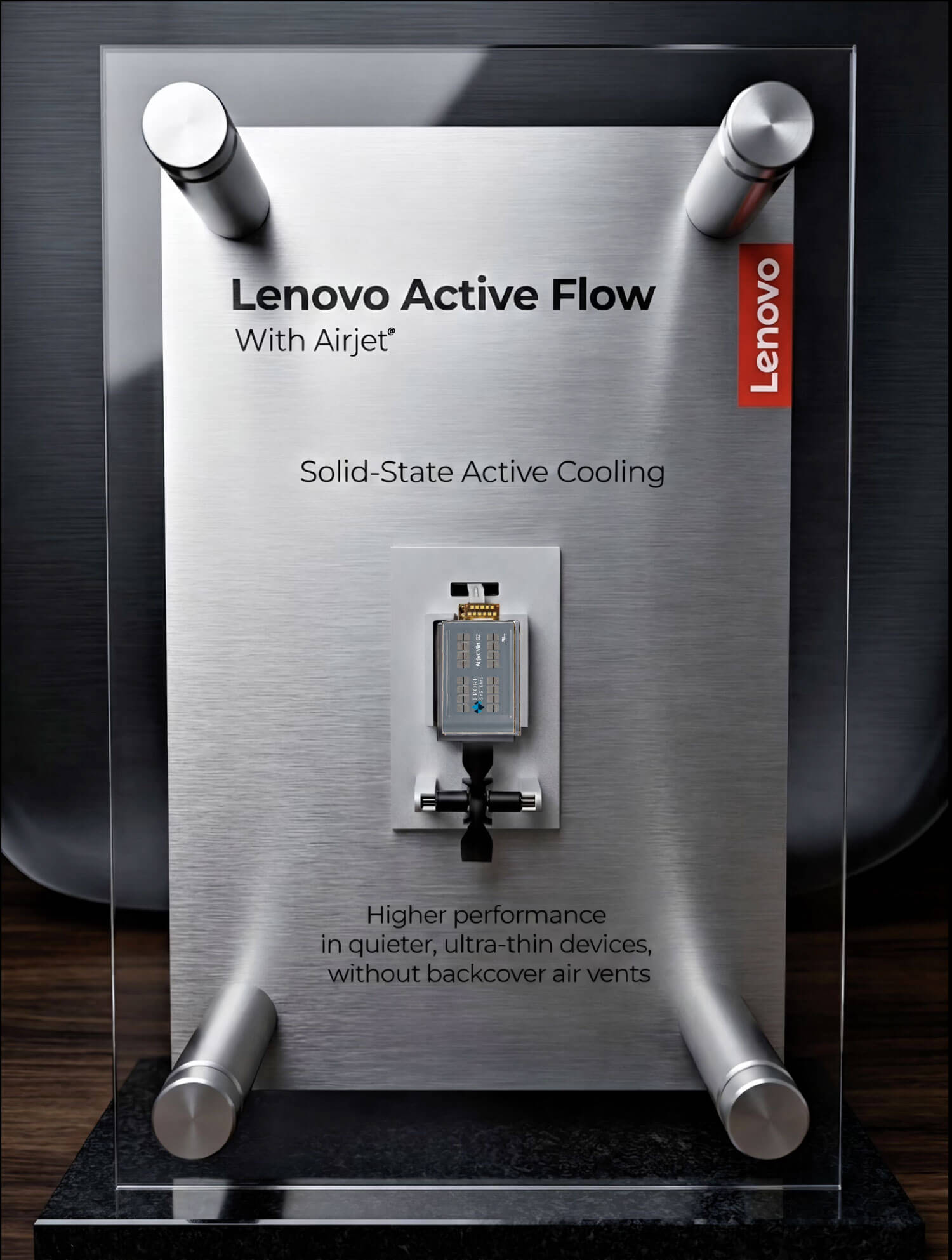
Lenovo’s breakthrough Active Flow thermal solution, developed in collaboration with Frore Systems, replaces traditional fan-based cooling with a solid-state active cooling architecture powered by AirJet® technology.​

For decades, making laptops thinner has meant sacrificing sustained performance. Lenovo Active Flow Thermal Solution powered by AirJet challenges that convention, enabling sustained performance while reducing noise, dust intake, and mechanical complexity. The result is a quieter, cleaner computing experience that feels equally at home on a desk, on a couch, in a coffee shop, or while traveling – without the performance compromises traditionally associated with fanless PCs.​

AirJet features:​

7.5 W heat removal per chip.​
Ultra-thin, whisper-quiet (<21 dBA), ​
Water-resistant. No fan noise.​
No dust buildup. Just pure performance.​

Performance you can see and feel.​

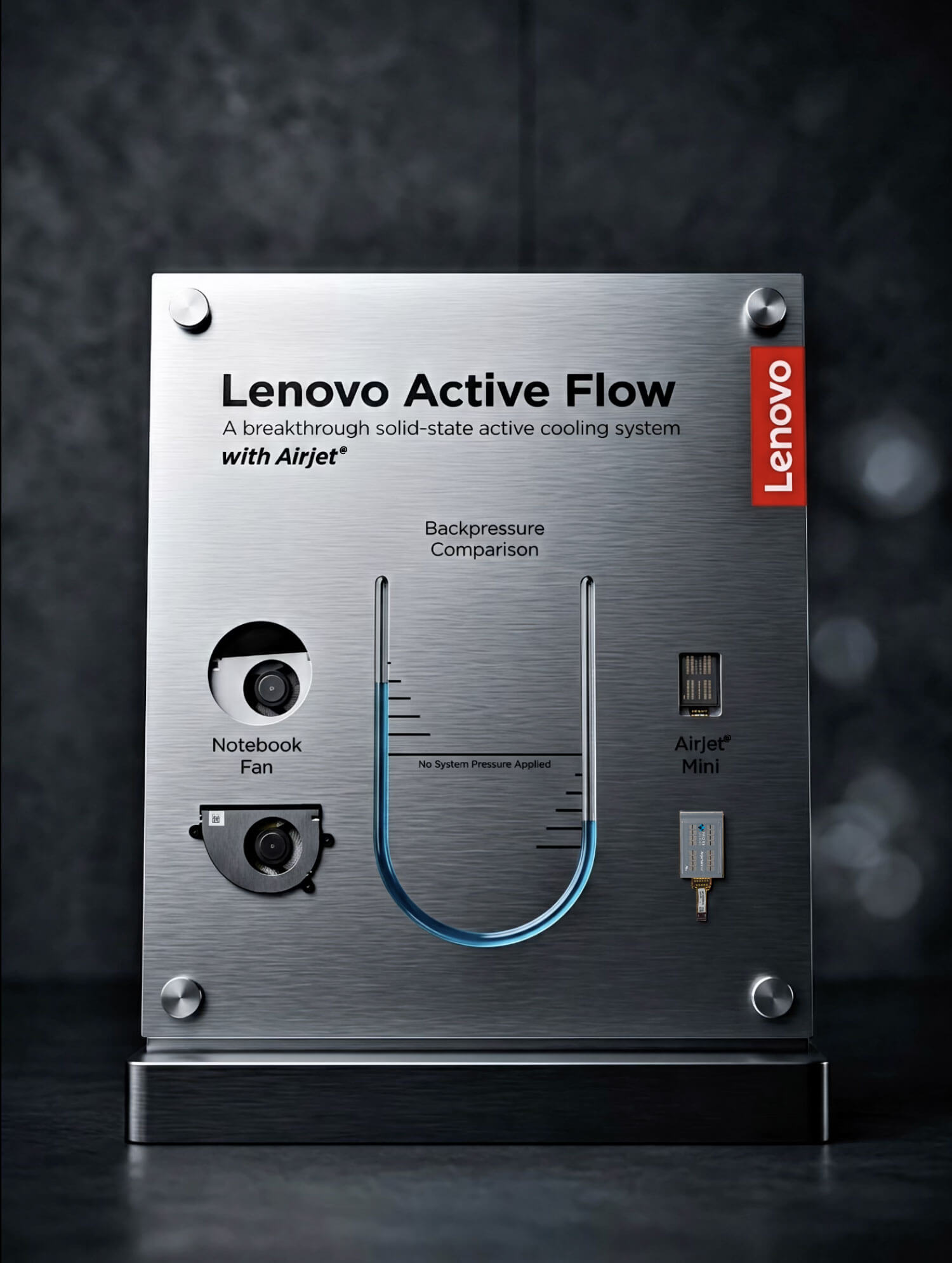
Demonstration 1: Backpressure Comparison

Head to head superiority

AirJet Mini generates 2000 Pascals of backpressure in a chip much smaller than a notebook fan. AirJet’s high backpressure creates suction powerful enough to pull air through the most compact enclosures, even in rugged embedded systems.​

This demonstration shows AirJet performance vs a traditional notebook fan in a head-to-head comparison. When both systems are operating, AirJet’s 2000 Pascals of backpressure overwhelms the notebook fan's meager 200 Pascals. AirJet’s 10x higher backpressure forces the blue liquid back through the tube towards the fan – in a reverse backpressure tug of war – forcing the liquid to rise up on the left of the demonstration.​

AirJet delivers significant benefits for the user experience.

Higher sustained compute performance – without compromise​
Reduced noise​
Reduced dust intake​
A back cover with no large air vents​​

Dust? Water? No problem.

The massive 2000 pascals of backpressure delivered by Airjet, enables air to be pulled into ultra-compact host devices, even devices protected by dustproof and water-resistant filters. The system is also designed to safely eject any particles entering the AirJet without clogging or degrading performance.​

Demonstration 2:  AirJet Air Flow​

So quiet we have to prove it’s turned on​

AirJet Mini moves air with vibrating piezoelectric membranes, creating massive backpressure and pulling air through the host system and into the chip.​​

AirJet is so quiet, we literally have to show it in action.  The air moving the spinning wheel in this demonstration, is ejected from the AirJet and, when embedded in a working device, is fully saturated with heat.​​

AirJet operates completely differently to the traditional notebook fan that blows air across a heat sink, picking up a modest percentage of heat as it moves.  AirJet removes heat as it pulls air through the system, but the bulk of the heat removal happens inside the AirJet chip itself – which is a fully self-contained active heat sink module - no additional fans or heat sinks are needed.​​

AirJet’s innovative design features vibrating piezoelectric membranes, which move air through the chip at extremely high speeds - up to an astonishing 200km per hour (124.3 miles per hour).  The air is pulled into the chip and then forced through tiny holes in the upper section of the AirJet, resembling a shower head, to create rapidly pulsating jets of high-speed air.  These jets of air then cross an extremely thin, 300-micron gap inside the chip, and vertically impinge onto the hot copper spreader which forms the base of the AirJet. The pulsating jets destroy the boundary layer of air that usually inhibits heat transfer for the traditional fan. This process of disrupting the boundary layer enables AirJet to achieve an extremely high heat transfer efficiency.

With the boundary layer gone, the heat is easily absorbed into the air inside the AirJet, completely saturating it. This heat saturated air is then completely ejected from the AirJet chip through a side exit spout.​

​Learn more about the Boundary layer and how destroying it maximizes heat transfer.​

Airjet Mini Data Sheet

Download PDF

2x Improvement in Super Slim 13” Notebook 

2x Improvement in Super Slim 13” Notebook

Download PDF

2x Performance Improvement in
6mm Pro Tablet

Download PDF

AirJet unleashes AI performance.​

AirJet® is the world’s thinnest and most powerful solid-state active cooling chip. Developed by Frore Systems, AirJet is a revolutionary, fully self-contained active heat sink module. AirJet is silent, thin, light, dustproof, vibration free, water-resistant and outperforms fans.​​

Built for the next generation of AI devices — from ultra thin notebooks and 2in1 tablets to 5G hotspots — AirJet turns thermal into a strategic advantage.​​

Learn more about AirJet.